
Android app testedUpdated 14 November 2026
Bumble Review:
Our Android app test
Bumble combines a polished dating app with prompts, practical profile details and free chat after matching. We like the substance beneath the photos, although paid filters, upgrade prompts and expiring matches need a closer look.
Review by the DatingHelp editorial teamHands-on Android test · UK audience and price researchAd: we may earn commission through our links.

4.0Very good
Average of five criteria · see details

Bumble
Thoughtful profiles, with a familiar swipe-style start
- Free conversations after a mutual match
- Prompts, interests and relationship goals
- Discover recommendations and useful filters
4.0Very goodSee our ratings
Bumble Premium
£9.99 / 7 days
ⓘ
UK iPhone price example checked 14 November 2026: £9.99 total for seven days of Premium. Offers vary; check your full charge and renewal.
Ad
Who is it for?
You want dates with a clearer sense of the person
Dates or a relationshipPersonality-led profilesFree mutual-match chat
- Best suited to
- Singles seeking dates
- Age fit
- 20–40
- Minimum age
- 18+
- Free membership
- Limited likes; chat after a mutual match
Activity · editorial rating4.0 / 5High · established UK reach
Starting a conversationEither personCurrent guidance gives each match 72 hours
App testedAndroidiPhone version also available
Contents
Our detailed ratings
Bumble feels modern and comfortable to browse, with clear navigation and readable profile sections. Photos, interests and short answers have room to breathe. Fuller profiles take quite a bit of scrolling, though, and the floating SuperSwipe star and repeated upgrade prompts compete with the person you are trying to read about.
Bumble gives you useful ways to make a more considered choice. Prompts, valued qualities, relationship goals and family details can reveal common ground before a conversation, while Discover offers another route beyond the main card stack. Free mutual-match chat is a real strength; incoming likes, advanced filters and Travel sit behind Premium.
Bumble offers a credible starting point for UK dating thanks to its substantial national audience. Ofcom places it among the country’s most-used dating services, although reports of thin local selections temper that reach. Nearby choice still matters more than the national headline, and the app does not show who is currently online or recently active.
Bumble can support an intentional search for a partner, but it serves several kinds of dating. Relationship and family fields help you spot compatible plans, while prompts give people a chance to show personality. Optional detail means profiles vary in substance, and verification and reporting tools cannot establish someone’s intentions for you.
Bumble’s free version provides good everyday value because matching can lead to a conversation without a subscription. Premium has a practical case when its filters or incoming likes save you time. The £9.99 seven-day Premium example keeps the initial commitment short, but is expensive for a brief upgrade. Premium+ and separate visibility purchases are harder to justify on hope alone.
Each criterion contributes 20% to our overall score of 4.0/5 · Very good.
Bumble: what to expect
Bumble is a mainstream dating app for people looking for dates or a relationship. Profiles combine photographs with prompts, interests and practical details, and a mutual match opens a free conversation.
Our Android test left a positive impression of its clear design and profile depth. The persistent upgrade offers and expiring matches are less appealing. Here we look at how browsing and contact work, the evidence for UK choice and whether the paid tools justify their cost.
How we tested: We used an existing free Android account on 14 November 2026 to inspect profiles, discovery, editing tools, filters, paid offers and safety help. We made two ordinary likes and two passes, sent no messages and bought no paid features. UK prices and audience figures come from separate research. Screenshots are genuine, with identifying details concealed. Age fit is an editorial guide.
Advantages and disadvantages
What we liked
- Free conversations after a mutual match
- Prompts and practical details add substance to profiles
- Clear, modern design with readable sections
- Discover offers a second route to compatible interests and goals
- Relationship, family and lifestyle filters help focus a paid search
What could be better
- Advanced filters and the incoming likes list require payment
- Fuller profiles involve plenty of scrolling
- Upgrade prompts and attention extras are persistent
- Matches still expire if the conversation does not begin in time
- No online or recent-activity indicator to judge availability
Design and everyday use
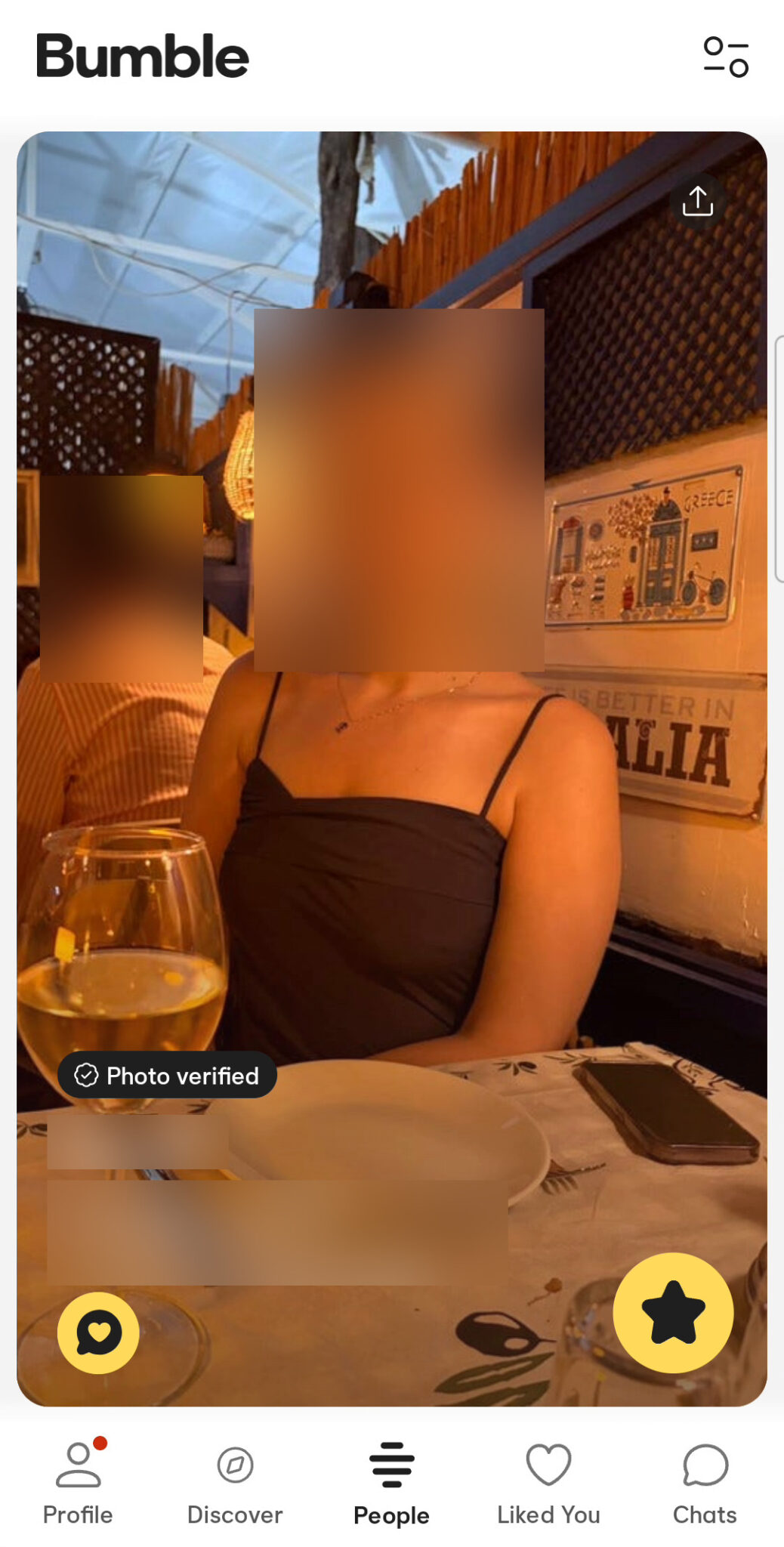
Moving between finding people, reading profiles and returning to a conversation feels straightforward in Bumble. People is the main profile feed; Discover gives you recommendations, Liked You collects incoming interest and Chats holds conversations. Those destinations sit in the bottom navigation alongside your own Profile. White space, rounded cards and yellow highlights keep the layout approachable, with readable separation between photos, written answers and practical details.
The People screen gives the photograph most of the attention. It is quick to grasp, but a considered decision means scrolling. The profile can continue through several pictures, interests, lifestyle information and answers, with contact entry points along the way. The floating yellow SuperSwipe star stays prominent and can crowd the lower reading area.
Discover offers another way to find people alongside the main People feed. A horizontal Recommended for you selection sits with groups based on shared interests and dating goals. Bumble says the suggestions draw on your profile and past matches. The interest and goal groupings give you a more useful starting point than a photograph alone.
We preferred the calm profile sections to the account dashboard, where completion advice, paid plans and visibility extras compete for attention. The everyday navigation is tidy; the selling is the main interruption.
Profiles: personality, practicalities and the effort people put in
A Bumble profile can help you work out whether the attraction extends to the kind of relationship and everyday life you want. The builder combines six photo or video positions with a bio, short written prompts and interest badges. You can also choose up to three causes or communities and three qualities you value in a partner, giving someone more to ask about than where a holiday photograph was taken.
Practical fields cover work, education, height, exercise, drinking, smoking, relationship intentions, children, politics, religion and languages. Family plans are particularly useful for spotting a mismatch before a conversation. Some of that information is personal, so choose what you are comfortable including in an introduction.
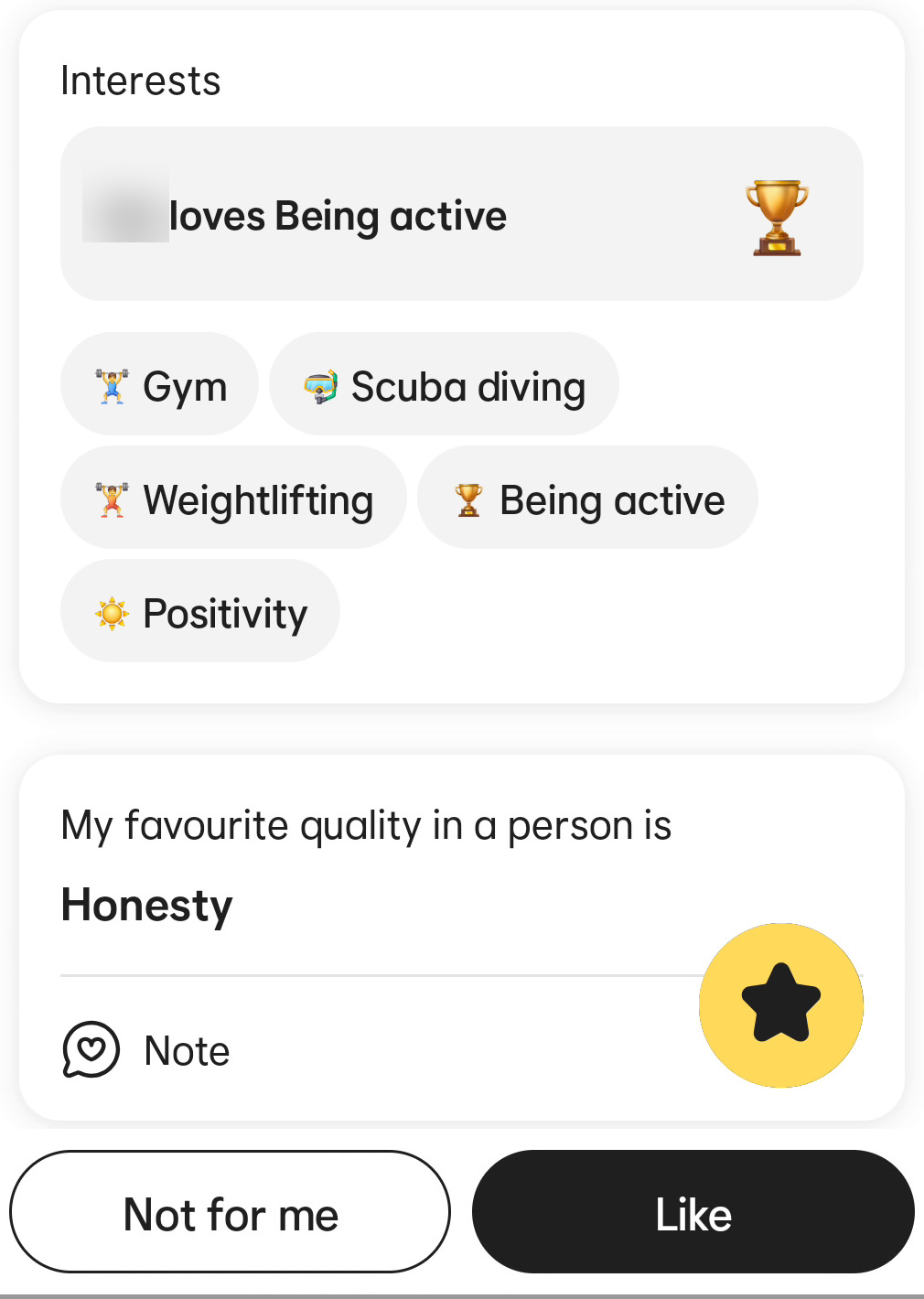
The profiles we read varied. One bio described a wish for a warm, mature connection; another profile relied mainly on practical fields and interests. A fuller example combined relationship plans, lifestyle details and several photographs with a one-word answer about a valued quality. The format provides room for substance, but it does not make every member use that room well.
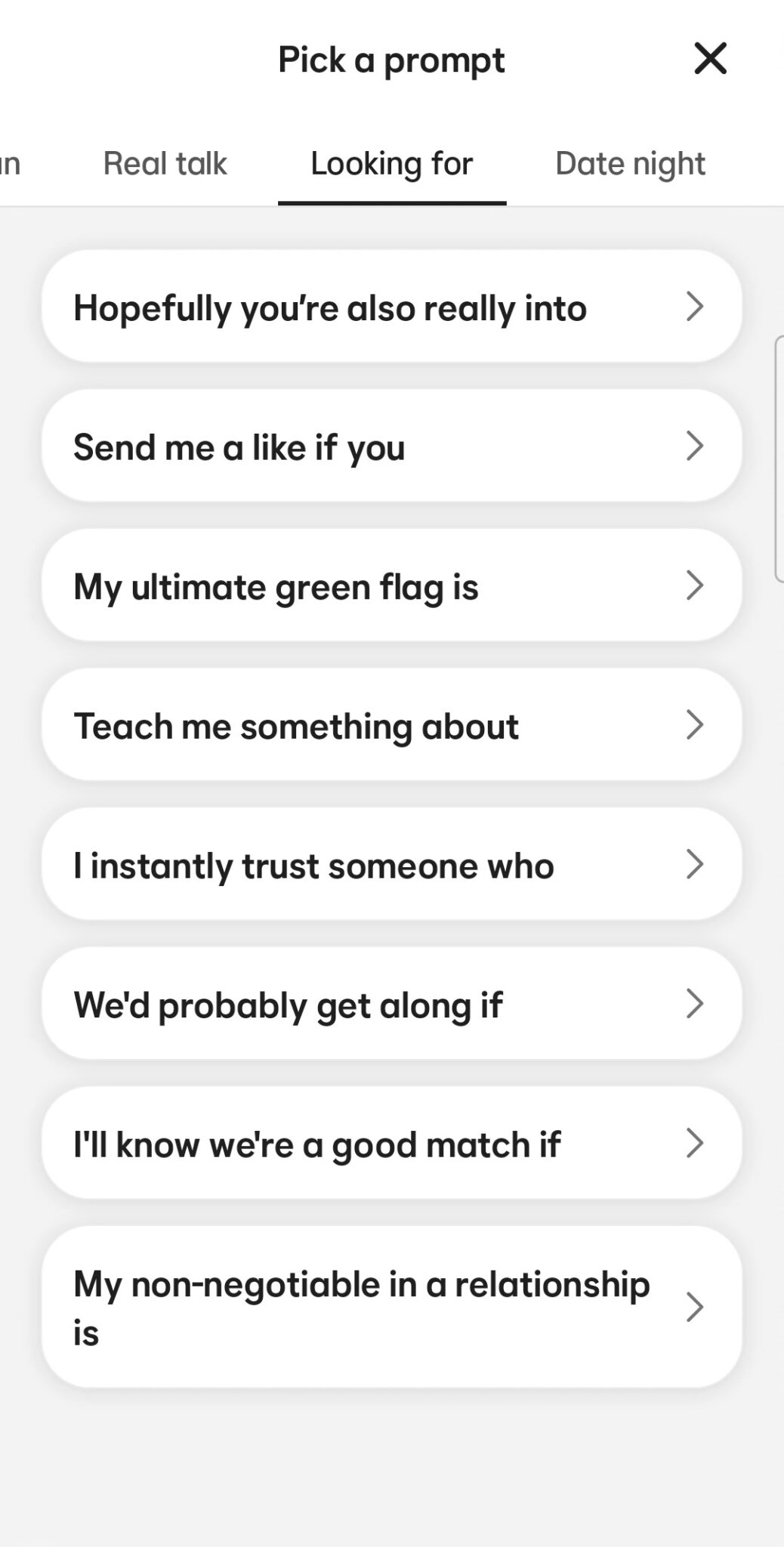
That is where prompts can help. The library separates everyday personality, fun, opinions, relationship preferences and dates. Questions about a green flag or a non-negotiable in a relationship give someone a clear starting point. A specific answer also gives a match something to ask about. “Honesty” is reassuring, but an example usually leaves more room for a conversation.
The editor also offered Best Photo and AI photo feedback to help with presentation. We did not try the feedback, so cannot judge its advice. Profile-completion tips also sit close to paid offers, so even editing your introduction brings another dose of upselling.
Discovery and filters: useful control, with a paid boundary
Preferences help you shape the people Bumble recommends, so the feed is closer to the dates you would actually consider. The basic choices cover who you want to date, age and distance, with interests, verification and languages also available. Separate switches allow relevant people outside a range. Leave expansion enabled for a wider choice, or check those switches if your age or travel limits are firm.
The advanced tab is where Bumble becomes more selective. We saw height, relationship intentions, family plans, children, religion, education, politics and lifestyle options. These can save time when a shared plan really matters, but the Unlock Premium button made the paid boundary clear.
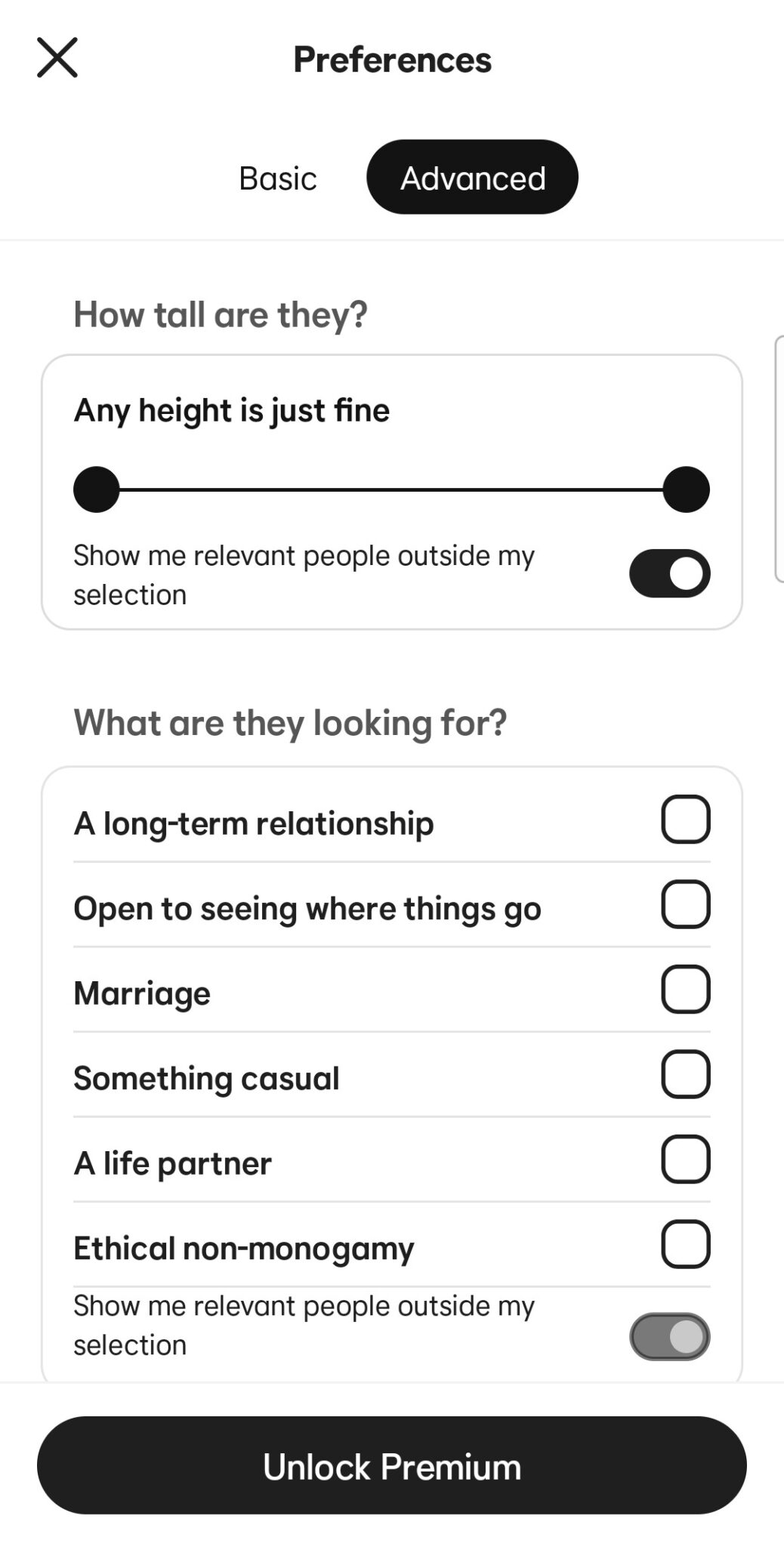
Bumble’s filter guidance says you must include a detail on your own profile before filtering others by it. That encourages a useful degree of reciprocity. Very narrow preferences also reduce the selection; a carefully chosen filter should solve a real mismatch, not turn a possible date into a specification sheet.
For another city, Travel Mode is the official route. It requires Premium or Premium+, shows a Travel banner and changes where your profile appears virtually. Bumble normally uses the phone’s GPS location. A VPN does not establish that you are browsing a particular city.
Who can message first? The current Bumble rules
When two people like one another, Bumble creates a match and either can begin a free conversation. Under Bumble’s current guidance, each has 72 hours after matching to send an opening message; once one person starts, the other gets 72 hours to reply. If nobody begins within the original window, the match expires. A pre-match Note counts as an opening message, and the older Opening Moves system has been removed.
The deadline gives a match a reason to move beyond a pair of likes. It can also be awkward in a busy week. Extend keeps a match open for longer: Bumble says everyone gets one free use a day, with unlimited extensions on paid plans.
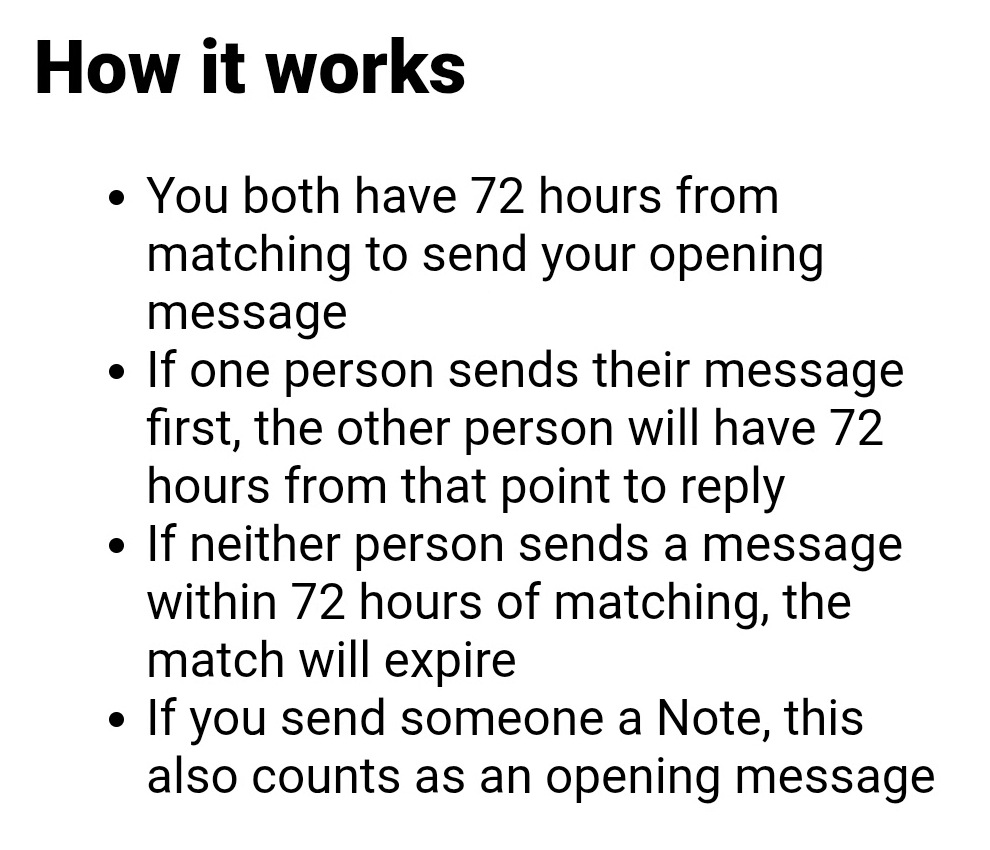
The conversation tools include voice notes, video calls, photos and a Question Game. Calling within the app can help you get acquainted before sharing a phone number. Notes offer a pre-match message based on a photo or prompt and are a separate attention feature, not a requirement for ordinary mutual-match chat.
Bumble does not provide read receipts or online and recent-activity status. That removes some pressure to explain every delay, but also leaves you with less information about whether somebody has been back. Our test did not include conversations or call quality.
How active is Bumble in the UK?
Bumble has the national reach to make it a worthwhile UK dating option. We assess activity as High, with more confidence in that broad audience than in the choice available in any particular neighbourhood.
In Ofcom’s Online Nation 2025 report, Ipsos iris measured roughly 1.1 million UK adult visitors in May 2025, or 2.3% of UK online adults. That placed Bumble third among the dating services shown, behind Tinder and Hinge at about 1.5 million each. Its audience was broadly unchanged from May 2024 and below the 1.4 million measured in May 2023.
Our Android test did not measure a UK profile pool. The app did not expose a total matching selection and has no online or recent-activity indicator, so we could not count active profiles or their share. The national figures give the wider context; they cannot tell you who is available nearby today.
British Trustpilot reviewers described thin selections, disappointing paid value and difficulty reaching support. One London reviewer reported running out of profiles quickly. Those accounts make the free local feed worth examining carefully before paying for greater visibility. The UK App Store was more positive at around 4.2/5 when checked, which also cautions against treating the complaints as the whole experience.
Bumble prices in the UK and what you get
The free service covers profiles, a limited daily like allowance, matching and ordinary conversations after a mutual match. That is enough to find out whether the app interests you. Paid plans mainly buy more browsing control, convenience and visibility.
| Plan | Main additional value | Our view |
|---|---|---|
| Boost | Unlimited likes; Backtrack to revisit a mistaken pass; rematching and longer match windows; weekly attention extras | Useful if the free allowance or a mistaken pass is a regular frustration |
| Premium | Boost benefits plus incoming likes, advanced filters, Incognito and Travel | The clearer practical upgrade for selective browsing |
| Premium+ | Premium benefits plus photo insights, priority visibility and larger weekly extras | More speculative value if your main problem is a quiet selection |
The official plan comparison lists five SuperSwipes and one Spotlight each week for Boost, and two Notes, ten SuperSwipes and two Spotlights for Premium+. Check your plan’s allocation and whether unused extras expire.
A seven-day UK Premium price
The UK iPhone catalogue listed seven days of Bumble Premium for £9.99 in total when checked on 14 November 2026.
| Plan and purchase route | Term | Total payment |
|---|---|---|
| Bumble Premium · UK Apple catalogue | 7 days | £9.99 |
Offers vary by tier, duration and purchase route. Check the full charge, included extras and renewal price before buying; separate attention purchases cost extra. We could not establish the renewal amount for this catalogue entry or complete UK tariffs for Boost or Premium+.
For us, Premium has the clearest reason to exist: seeing incoming interest and filtering for important plans can save time. Boost suits a different frustration, such as regularly reaching the free allowance. Premium+ asks you to place more value on being seen sooner and more often.
Spotlight’s in-app promotion promised more profile views, while SuperSwipes and Notes offer a more conspicuous introduction. More visibility is not a date or a reply, so we would be cautious about buying another extra simply because a week has been quiet.
Subscriptions renew automatically unless cancelled. Cancellation follows the purchase route: Apple subscriptions through Apple, Google Play purchases through Google Play, and direct payment arrangements through Bumble’s subscription controls. Removing the app is not a cancellation method. Check the next charge as carefully as the introductory offer.
Intentions, privacy and safety
Bumble can suit people seeking a partner, and its intentions include marriage and a life partner alongside more casual dating and ethical non-monogamy. The label on one profile matters more than a broad promise about the app. Read the combination of goals and family plans, then discuss what you both mean by them.
For unwanted contact or a worrying profile, Report and Block provide routes to raise a concern or stop contact. The reporting introduction said the person would not be told who reported them. We also saw photo-verification badges and a Help Hub bringing together safety topics and report notifications, making the available help easier to find when you need it.
Those are useful safeguards and support routes. They do not prove that every profile is genuine or that support will resolve a complaint quickly. Bumble’s official safety guidance also describes ID verification, potentially explicit-image blurring and scam detection. We did not submit an ID or test the moderation outcome of a report.
Settings separate Snooze, Incognito and location tools. Snooze offers a break from discovery; Premium’s Incognito limits visibility to people you have chosen. Your GPS-derived general area still deserves thought.
Two older claims need clearing up: Bumble Bizz is no longer available, so this is not a current business-networking recommendation. BFF remains a separate friendship proposition, with availability and app arrangements varying by region. Also, the Share Date help page currently marks that feature unavailable while improvements are made, despite its continued appearance in some marketing.
Frequently asked questions
Yes. You can view profiles, send a limited number of ordinary likes, match and chat with mutual matches without buying a subscription. Advanced filters, incoming likes and other convenience tools require a paid plan.
No. Current Bumble guidance lets either person send one opening message. Each has 72 hours after matching to start; the recipient then has 72 hours to reply. Opening Moves have been removed.
The UK iPhone price example checked on 14 November 2026 was £9.99 in total for seven days of Bumble Premium. Offers vary by tier, duration and purchase route, so check the full payment and renewal price in your account before buying.
Boost adds unlimited likes, Backtrack and other matching extras. Premium adds the incoming likes list, advanced filters, Incognito and Travel. Premium+ adds photo insights, priority exposure and larger weekly extras. Check the current offer for exact allocations.
No. Bumble says it does not show online or recent-activity status, and it has no read receipts. A profile in your feed does not establish that the person has recently opened the app.
A VPN alone does not establish a London dating location. Bumble normally uses the phone’s GPS. Premium or Premium+ Travel Mode provides a virtual location and adds a Travel banner to the profile.
No. Its profile intentions cover lasting relationships and several other kinds of dating. Practical fields and prompts can help you assess fit, but read each person’s intentions rather than assuming everyone wants the same thing.
Our verdict: worth trying for the profiles and the free chat
Bumble earns 4.0/5 · Very good. It gives you a comfortable interface, room for more personal profiles and an established UK audience. The free matching and chat route makes it possible to explore those strengths before deciding whether an upgrade solves a real problem.
The trade-offs are the scrolling, the paid search controls and the persistent offers to be noticed. We would put the first effort into a few useful photographs and specific answers. Premium can make a good selection easier to navigate; a more expensive visibility package deserves a clearer reason than a hopeful tap.
Bumble · 4.0/5 · Very good
A polished dating app with useful profile depth and a worthwhile free starting point
Ad
Compare before you choose
Alternatives to Bumble

Hinge
4.2Very good
Structured profiles and prompt-based interest for relationship-minded dating.
Ad

Tinder
4.0Very good
A broad range of dating intentions and free chat after mutual interest.
Ad

eharmony
4.0Very good
Compatibility insights and detailed profiles for a more structured relationship search.
Ad
Bumble
4.0Very good
Bumble Premium
£9.99 / 7 days
ⓘ
UK iPhone price example checked 14 November 2026: £9.99 total for seven days of Premium. Offers vary; check your full charge and renewal.
Ad