
Website testedUpdated 16 November 2026
Match Review:
Costs & our verdict
Match gives you room to look beyond a photograph. We explore its profiles, London search results and free features, then weigh the Standard and Premium plans against the commitment they ask of you.
Review by the DatingHelp editorial teamHands-on website test · UK sources and customer feedback

4.4Very good
Average of five criteria · see details

Match
For singles looking for a lasting relationship
- Detailed profiles, prompts and values
- Search by distance and activity
- Standard web plan includes messaging
4.4Very goodSee our ratings
Standard from £19.99 / month See every plan
6 months · £119.94 total · 6 monthly payments
Ad · We may earn a commission.
Who is it for?
You want a lasting relationship
A lasting relationshipDetailed profilesLocal search
- Best suited to
- Serious singles
- Minimum age
- 18+
- Basic membership
- Free, with limited contact
Activity · editorial rating5.0 / 5
MessagingStandard & PremiumUnlimited on the web
Subscription terms seen1 week, 1 or 6 months
Contents
Our detailed ratings
Match is easy to find your way around on desktop, with a useful search overview and clearly separated profile sections. Photographs, values and prompts are readable without feeling cramped. Upgrade invitations interrupt that calm, and the website retained awkwardly wide panels in our narrow-browser check, making search and settings less comfortable.
Match gives relationship-minded singles a broad set of tools for making considered choices. Detailed profiles, practical preferences, activity sorting and a searchable local selection work well together. Standard on the web includes unlimited messaging; Premium adds advanced filters and weekly Super Likes. The family and lifestyle filters are useful enough that their paid restriction matters.
There was substantial choice and visible life in our London search, with hundreds of profiles carrying online or activity indicators. It felt worth exploring beyond the first few recommendations. Match also has an established UK audience, although the national figure and our city search answer different questions: suitable local people and their willingness to reply still depend on your circumstances.
Match is a convincing fit for people looking for a committed relationship. Values, prompts, family details and dating intentions help you assess how two lives might fit together. Photo and age checks add reassurance, with a meaningful biometric privacy trade-off. They cannot establish somebody’s relationship status, honesty or intentions.
Standard can offer good value when the local profiles interest you, because the web plan already includes messaging and viewing likes and visits. Six months brings the monthly cost down considerably, but £119.94 remains the commitment even when paid in instalments. Premium’s extra £30 over that term is most persuasive if its advanced filters solve a real problem for you.
Each of the five criteria contributes 20% to our overall score of 4.4/5 · Very good.
Our experience: enough detail to make a proper choice
Match makes most sense when you want to know a little about somebody’s life before deciding whether to start a conversation. A photograph still gets the first word, but values, personal prompts and practical details give the rest of the profile a chance to speak.
We liked having a searchable overview alongside the one-person-at-a-time recommendations. Our London search was substantial, and opening a profile brought together photographs, recent activity and details that could matter well beyond the first date. The experience has more substance than an endless row of attractive faces.
There is also plenty of selling. Boosts, Super Likes and subscription invitations appear around ordinary browsing, while some of the most useful relationship filters are reserved for Premium. The important buying decision is whether a particular restriction is getting in your way. Paying for a louder introduction is a different proposition from paying for a filter that saves you an evening of unsuitable browsing.
How we tested: We used a free editorial account on 16 November 2026, exploring profiles, navigation, search, filters, safety settings and GBP web offers. Our local study covered women aged 28–41 around London. We inspected the website in desktop and narrow-browser views; the installed apps were researched separately. We sent no likes or member messages and bought nothing, so this review does not measure replies or paid membership performance. The account’s final verification badge and external visibility were not independently confirmed. Age fit is an editorial guide, not a measured age distribution.
Advantages and disadvantages
What we liked
- Profiles combine photographs, values, prompts and practical details
- Search gives you an overview of local people and their activity
- Our London selection offered substantial choice
- Standard web membership includes unlimited messaging
- Visible and Hidden settings give you basic control over your profile
What could be better
- Advanced family and lifestyle filters require Premium in our web offer
- Six-month instalments still mean a six-month financial commitment
- Upgrade and visibility promotions compete for attention
- Search and settings needed horizontal scrolling in a narrow browser
- Verification involves sensitive data and does not guarantee trustworthiness
Getting started and building your profile
Registration involves more than choosing a username and finding a flattering photograph. Our route included personal questions, a photo upload, SMS confirmation and a video-selfie Face Check. Some questions could be skipped; others, including ethnicity in our registration flow, required an answer. That distinction deserves attention if you prefer to disclose as little as possible.
The profile editor is sensibly divided into Summary, About me, More, Topics, Values and Interests. You can add depth over time, and the missing-answer reminders make it clear where there is still room to say something useful.
For somebody actually looking for a partner, the Summary is a chance to give the facts a voice. A list of interests can say you like food and travelling; a short, specific account of your ordinary weekend can help another person imagine enjoying it with you. There is room for that here without trying to squeeze a personality into one sentence.
Prompts and values give people a place to begin
Topics break the profile into smaller, more approachable pieces. In a member profile we explored, a comfort-show answer and a modest ambition to improve their cooking added a little everyday personality. Neither was a grand romantic declaration. Both were easier to respond to than an empty biography.
Values appear as illustrated cards, such as loyalty, friendship or humour. They are easy to scan and give the page a warmer feel than a questionnaire printout. They are also self-descriptions: selecting kindness does not establish how somebody behaves when a date goes badly. The useful part is the conversation the value can open.
Practical fields cover matters such as children, education, faith, smoking, drinking and dating intentions. A completed profile can help you spot meaningful differences early. An unanswered field remains unanswered; “I’ll tell you later” is an invitation to ask, not permission to fill in the blank yourself.
How profiles look: roomy, personal and quite long
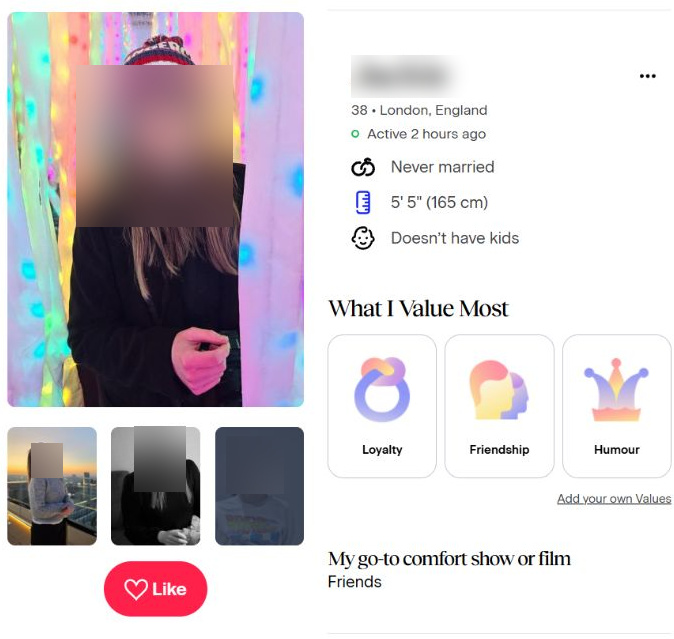
The desktop design gives photographs a substantial column on the left, with the person’s details and answers alongside them. Rounded image corners, generous white space and serif headings make it feel calmer than a crowded directory. The gallery and thumbnails let you look beyond one carefully selected lead photograph.
We particularly liked seeing activity information close to the name and basic details. One opened profile gave an actual last-use time; another said it had been active yesterday. That is more useful when deciding where to spend your attention than a vague claim about millions of members.
The space comes at a cost. A fuller Summary, several Topics and the lifestyle sections mean a fair amount of scrolling. Some lifestyle answers rely on icons to explain their meaning, so you need to pay attention to context. The large photographs remain visually dominant, even when there is plenty of written material below them.
Profile quality also depends on what people put into the format. Match provides room for a thoughtful introduction, but a row of missing answers and a couple of stock phrases cannot tell you much. Our strongest impression was of a useful structure with quite different levels of effort inside it.
Finding people: recommendations and a searchable overview
Discover introduces recommended profiles one at a time, with an Online option alongside All. This suits a slower look at each person, but it is not the only way to browse. Search gives you a grid, which is much better when you want to get a feel for the local choice.
Age and distance sit in a plain sentence above the results. We could change the radius around London and sort by activity date, newest first, age, photo count or distance. Mutual Search and Reverse Search were also listed. Activity sorting is especially useful when you want to prioritise people who have been back to the service.
The grid shows photographs, age, location and an activity label where available. Opening a profile gives those first impressions more context. There is a good balance here: a broad overview when you are exploring, followed by enough detail to slow down when somebody interests you.
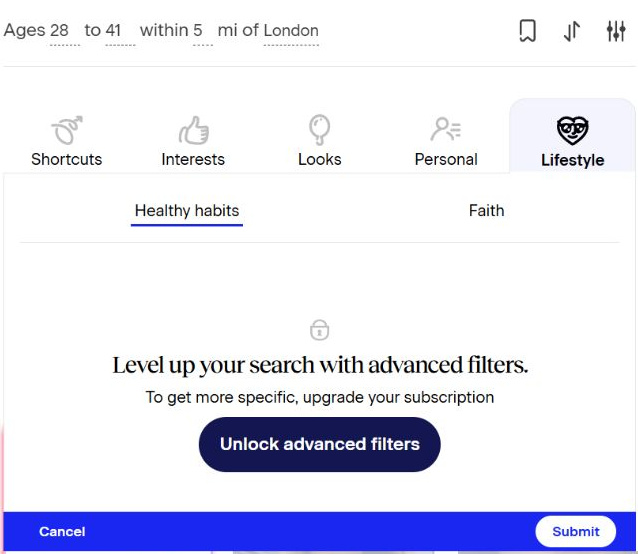
Search also offered an online-only filter and a verified-profile filter. The more selective categories—family, education, languages, interests, height and lifestyle—led to an upgrade invitation on our free account. Being able to see that a profile mentions children is not the same benefit as filtering the whole selection by family plans.
Highlights and paid visibility
Highlights presented a separate selection of standout members, described as curated daily. Our account had no Super Likes available and offered a purchase route beside that selection. It is another way to discover people, but the prominent presentation is also a route towards spending on extra attention.
Boosts aim to move your profile into a more visible position. That may appeal when a well-written profile is not getting noticed, although visibility and compatibility are different things. A better place in the queue still leaves the other person to decide whether they want to talk.
Match also advertises events and coaching. These broaden the service beyond profile browsing and may appeal if you prefer some structure around meeting people. Check the actual event, location and ticket conditions; a general promise of events does not establish that something suitable is running near you or included in your pass.
Free contact and what a subscription changes
The free account gave us a useful look around, including the paginated London search selection and full member profiles. That was more browsing than the UK FAQ’s description of up to six profiles at once might suggest. Treat the restriction shown on your own account as the practical guide.
Contact came with a wrinkle. Profile pages displayed a limited-time offer to start conversations with matches for free. The Matches area explained that mutual likes lead to chatting there. A temporary invitation can make a free trial more useful, but it is not a permanent promise of unrestricted messaging.
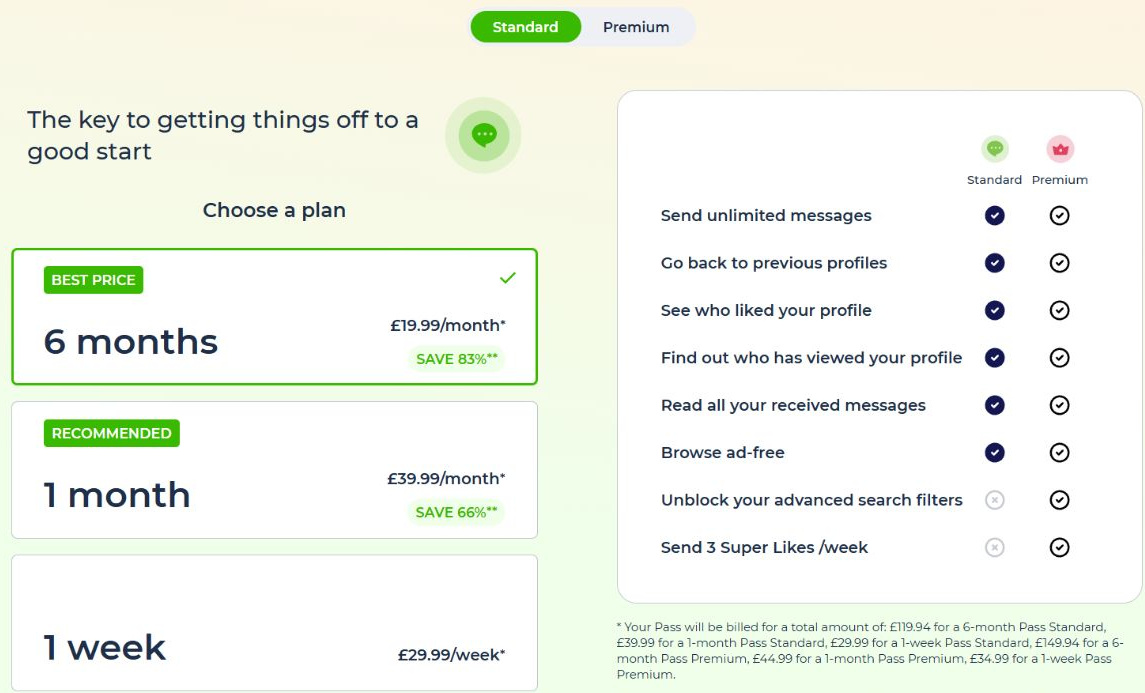
In our web offer, both Standard and Premium advertised unlimited outgoing messages, reading received messages, seeing likes and visitors, revisiting profiles and ad-free browsing. Premium added advanced search filters and three Super Likes a week. Standard therefore covered the central job of contacting people; Premium’s strongest practical attraction was more selective searching.
That is a more useful distinction than assuming the most expensive pass is the only serious option. If your non-negotiables concern children, faith or lifestyle, the extra filters could save time. If the basic search already produces people you want to get to know, the Standard toolkit may be enough.
UK activity: what our London search actually showed
There was plenty to explore locally. For women aged 28–41 within five miles of London, the result counter stayed around 1,600 profiles. We worked through the complete returned selection and recorded 1,623 distinct profile cards.
Across that traversal, 22 cards said Online now, 191 said Active and 85 said Recently active: 298 cards, or about 18.4%, carried one of those indicators. A separate online-only search displayed 26 profiles. These were live searches, so the numbers changed slightly as people came and went.
The remaining cards had no such label in the search display. That does not establish that all of them were abandoned. Nor should “Active” and “Recently active” be silently turned into one invented time window. Opened profiles sometimes supplied a more specific last-use time, which helped put the labels in context.
The practical conclusion is encouraging: even a modest share of a large local selection can leave you with many people worth considering. London is a large market, though, and these findings cannot tell a reader in another area how many suitable profiles they will see.
For national context, Ofcom’s Online Nation 2025 report measured Match at roughly 200,000 UK adult visitors in May 2025. That is an audience estimate, not a current count of paying or actively dating members. Match’s public claim that 2.6 million people have met someone through the service is based on a 2021 survey extrapolation; it is a historical success claim, not today’s local pool.
Match UK prices: Standard, Premium and the full commitment
The following GBP prices were displayed in our account’s UK web purchase route on 16 November 2026, including VAT. The one-week price is a weekly charge, not a monthly equivalent. Offers and app-store prices can differ.
| Plan | Term | Displayed rate | Full term total |
|---|---|---|---|
| Standard | 1 week | £29.99 / week | £29.99 |
| Standard | 1 month | £39.99 / month | £39.99 |
| Standard | 6 months | £19.99 / month | £119.94 |
| Premium | 1 week | £34.99 / week | £34.99 |
| Premium | 1 month | £44.99 / month | £44.99 |
| Premium | 6 months | £24.99 / month | £149.94 |
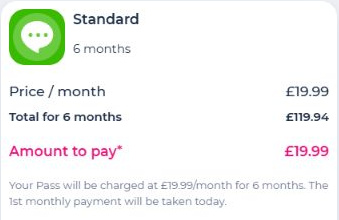
The six-month payment summaries offered six monthly instalments: £19.99 each for Standard or £24.99 each for Premium. This spreads payment; it does not turn either plan into a cancel-any-month subscription.
What the extra £30 buys over six months
Premium was £30 more than Standard over the six-month term. Its advanced filters are the clearest reason to pay that difference: they can narrow the selection around details that genuinely affect whether a relationship could work. Three weekly Super Likes are a more subjective benefit, especially if you are already comfortable sending a considered message.
The short plans cost much more for the time they cover, but they keep the total initial commitment smaller. A £29.99 Standard week is expensive as a long-term habit; £119.94 for six months is the bigger decision if you are not yet sure you like the local selection. Neither comparison should be reduced to the largest “save” badge on the offer.
Renewal, cancellation and extras
The six-month payment pages specified renewal for another six months at the same displayed rates: £119.94 for Standard or £149.94 for Premium, again in six payments. Other promotional offers may renew at a higher, non-discounted price.
The current terms say automatic renewal can normally be stopped from 24 hours after purchase until at least 48 hours before renewal, unless the purchase states otherwise. Turning renewal off leaves the remaining instalments for the current term payable. Removing the app does not cancel a subscription. Apple and Google purchases must be managed through the relevant store.
Boosts, additional Super Likes and private-browsing options can add to the cost. Match’s Private Mode guidance describes a Select upgrade, while Connect guidance says it lets non-subscribers reply to you. These are separate inclusions to check in your own purchase summary; do not assume “Premium” means every extra is included.
The iPhone route has different names and prices
The UK App Store listing named Premium at £19.99 for one week and £39.99 for one month when checked. Its description used Essential, Premium and Prestige, while our web offer used Standard and Premium. Those are researched store prices, separate from our observed web offer. Check Apple’s confirmation for the actual inclusions, billing and renewal terms. Generic amounts without a named duration are not useful monthly quotes.
Everyday usability and the mobile website
On desktop, the main navigation is straightforward: Discover, Highlights, Search, Likes and Matches stay in view, while profile and account settings sit behind the account menu. The search grid is a welcome alternative to making every decision in a single-profile feed.
The interface looks more considered than its age might lead you to expect. Profile typography has character, values are visually distinct, and the page has room to breathe. Repeated prompts to add photos or personal details are understandable, but the combination of those reminders, Boost panels and subscription banners can make a quiet browse feel like a busy shop floor.
We also encountered profile pages that stayed on loading placeholders after direct navigation; returning through Search produced the full profile. That was an interruption in the test, not enough evidence to diagnose a general outage.
The narrow-browser check was less comfortable. Search and Account settings retained wide panels, leaving controls or content off to the side and requiring horizontal scrolling. The mobile website did not adapt gracefully in that view. We have not tested the installed iPhone or Android apps, so their everyday usability is not established by this website check.
Seriousness, verification and privacy
Match’s profile structure supports a considered search for a relationship. Values and dating intentions add useful context, while family and lifestyle details help you think about the practical side of being together. The format makes room for seriousness; it cannot make every member serious on your behalf.
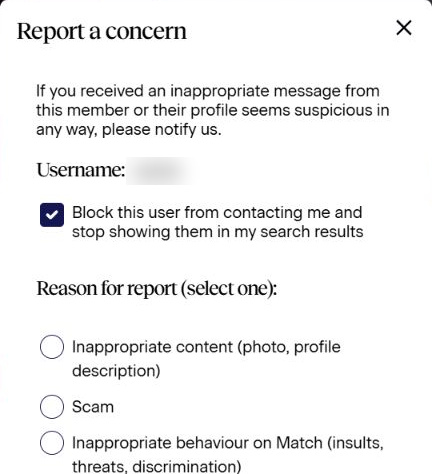
Block and Report were easy to find in the profile menu. The reporting form covered inappropriate content, suspected scams, behaviour on or outside Match, harassment and underage users. It also offered blocking alongside the report. That is a useful set of controls when something feels wrong, although the presence of a form does not tell us how well a particular report will be handled.
Face Check is a meaningful data decision
Match’s Face Check guidance describes a UK rollout using a video selfie for liveness, age estimation and checking profile photographs. The original video is deleted, but facial maps and vectors are retained for the life of the account and normally deleted within 30 days of closure, subject to stated exceptions. Two audit images and verification results have longer retention periods.
This is more than a quick photograph that disappears without a trace. Read the explanation and privacy policy before joining if biometric processing concerns you. A verification badge is useful evidence about a person’s photos; it does not establish their intentions, relationship status or safety.
Hiding your profile and browsing privately are different
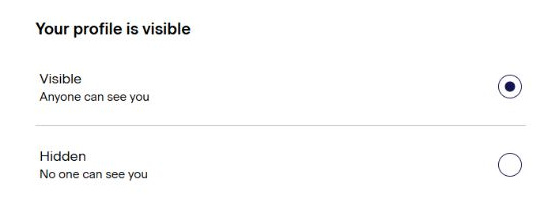
Account settings offered basic Visible and Hidden choices. Private Mode goes further: Match says it allows discreet browsing and limits visibility to people you choose to contact. Its purchase conditions need checking separately from the main subscription.
Profile visibility also extends beyond the brand name you first joined. The UK visibility explanation says profiles can appear on local variants using the same central platform. Visibility on category-specific services, such as those for older singles or single parents, depends on eligibility and consent. The guidance points to Settings for withdrawing that additional visibility.
What British customer feedback adds
The UK App Store showed 3.8/5 from about 42,000 ratings. The UK Match Trustpilot profile was much harsher, at 1.4/5 from roughly 5,600 reviews. Recent British-labelled feedback included complaints about renewal charges, verification difficulties, repeated profiles and support responses. A positive November account praised the relationship-minded audience.
These are self-selected experiences, not a measured success rate or proof that a particular profile is fraudulent. They do help identify the questions that matter before paying: whether your search feels promising, what your pass actually includes and when its financial commitment ends. Our own test supports the appeal of the profile format and local choice; it does not settle other customers’ support or billing disputes.
Frequently asked questions
Creating a profile and basic browsing are free. Our account could explore the paginated London selection and full profiles, while advanced filters were locked. Profile pages also advertised a limited-time free-conversation offer for matches. Do not assume that temporary offer means permanent, unrestricted free messaging.
Our UK web offer showed Standard at £29.99 for one week, £39.99 for one month or £119.94 for six months (£19.99 a month). Premium was £34.99 for one week, £44.99 for one month or £149.94 for six months (£24.99 a month). The six-month payment pages offered six monthly instalments. Prices were checked on 16 November 2026 and can vary by offer and purchase route.
In our web offer, both included unlimited messaging, reading messages, likes and visitor information, revisiting profiles and ad-free browsing. Premium also included advanced search filters and three Super Likes each week. App-store plan names and inclusions can differ.
Not if you choose a six-month term paid in instalments. The payment pages showed six payments of £19.99 for Standard or £24.99 for Premium, committing £119.94 or £149.94 respectively. Stopping automatic renewal does not remove the remaining payments for the current term.
Yes. Our six-month payment pages specified renewal for another six months at the same rates and totals, paid in six instalments. Promotional offers can have different renewal prices. The normal web cancellation window runs from 24 hours after purchase to at least 48 hours before renewal, unless the offer says otherwise; store purchases are managed through Apple or Google.
Our search for women aged 28–41 within five miles of London covered 1,623 distinct profile cards. During that traversal, 298 carried Online now, Active or Recently active labels. A separate online-only search returned 26 profiles. The live numbers changed slightly, and a missing label does not prove inactivity.
Its profile tools and positioning suit singles looking for a committed relationship, but intentions differ between people. Read the stated dating goals and practical details, then discuss the things that matter to you.
Current UK guidance describes a Face Check rollout using a video selfie. Our registration route included this step. The process involves biometric information and retention beyond the original video; read the current explanation before joining. A badge is not a guarantee of somebody’s intentions or safety.
Our verdict: a worthwhile search, with a real subscription decision
Match earns 4.4/5 · Very good. Its strongest qualities are the combination of a substantial local search, readable profiles and enough personal detail to make an informed first choice. We found plenty to explore in London, and the profile format gives people a reasonable chance to show what spending time with them might be like.
The friction deserves equal weight. Useful advanced filters sit behind Premium, upgrade promotions are persistent, and the website was awkward in a narrow browser. Verification also asks for sensitive data, while a six-month pass remains a six-month financial commitment even when the payments look monthly.
Standard on the web already covers messaging, which makes the buying decision clearer. Premium is worth considering when its filters improve the search you are actually making. For someone who wants a relationship and likes having more to read than a photograph and a one-liner, Match remains a strong option to explore.
Match · 4.4/5 · Very good
A substantial local search and room to get to know somebody beyond a photograph
Compare before you choose
Alternatives to Match

Ourtime
4.2Very good
For singles aged 50+ who prefer a community centred on their stage of life.
Ad

eharmony
4.0Very good
A more questionnaire-led route, with compatibility insights and detailed profiles.
Ad

C-Date
3.8Good
An alternative for casual dating, with a different relationship focus from Match.
Ad