
Free website testedUpdated 13 November 2026
Parship Review:
Our UK verdict
Parship has thoughtful profile and compatibility tools. But our repeated searches could not find a single UK profile, even with broad filters and a London connection. That makes it hard to recommend for dating in Britain.
Review by the DatingHelp editorial teamHands-on free web test · UK searches and current price research
Links marked Ad may earn us a commission if you join. The Parship link is non-commercial. This does not change our editorial assessment.

2.4Poor
Average of five criteria · see details

Parship
Questionnaire-led matching for serious relationships
- Personality, habits and interests compatibility
- Detailed facts and individual profile answers
- Free profile and questionnaire
2.4PoorSee our ratings
From £14.90 / month See prices
12 months · £178.80 initial total · auto-renews
Official website
Who is it for?
A serious relationship service with a practical UK problem
Long-term relationshipsPersonality matchingPaid messaging
- Intended audience
- Singles looking for a lasting relationship
- Minimum age
- 18+
- Our UK result
- No profiles displayed
- UK membership total
- Not verified
Activity · editorial rating0.5 / 5
Shortest paid term3 months · £89.70£29.90/month equivalent
Free membershipProfile and questionnaireFull analysis and communication are restricted
Contents
Our detailed ratings
Clear cards, generous space and a short main menu make Parship easy to find your way around. Practical profile facts sit apart from personal answers on desktop; the mobile website stacks them with a fixed bottom navigation bar. The layout stays readable, though long profiles mean plenty of scrolling on a smaller screen.
Parship gives you more to consider than a photograph and a vague match label. Compatibility is broken down into personality, habits and interests, while personal answers and everyday details help you judge how someone might fit into your life. The free personality report is only a preview, and photos, full communication and several search tools sit behind Premium.
Our searches for women in the UK gave us nobody to consider, an exceptionally weak practical result for dating in Britain. Repeated searches stayed empty even with broad settings. We could not assess recent UK activity, and the total British membership and the reason for the empty selection remain unknown.
Parship gives relationship intentions and the practicalities of sharing a life proper attention. Its questionnaire and family details help you assess whether your plans fit, and age verification was required in our registration. That suits a deliberate search for a partner, though the international visibility and broad profile-content rights in its terms deserve a read before sharing personal material.
There is little reason to pay for Premium after our free UK searches showed nobody to contact. Full communication and photos require Premium, with initial commitments of £89.70 for three months, £119.40 for six or £178.80 for twelve, paid upfront with automatic renewal. Detailed matching could justify a subscription where there is a useful local selection. A cheaper monthly equivalent over twelve months does not improve that value, and a conditional extension guarantee cannot create a convincing shortlist.
The five criteria carry equal weight. Their average gives Parship 2.4/5 · Poor. This assesses the service for UK dating, including our observed lack of profiles.
Our experience: good ideas need people
We did not find a single UK profile during our test. That is the first thing to know about Parship if you are considering it from Britain. We broadened the search repeatedly, including all seven UK regions listed by the service and its widest displayed adult age range. The result stayed empty.
It is frustrating because there are worthwhile ideas here. The questionnaire looks beyond appearance, profiles have room for everyday compatibility and personal answers, and the matching panel tries to explain its recommendation. We can see why someone tired of rapid-fire swiping might like the approach.
But the aim is to meet somebody. A thoughtful system with nobody appearing in our UK selection is not a service we can currently recommend paying for. A high match score cannot arrange coffee with an empty screen.
How we tested: On 13 November 2026 we completed registration and age verification, used a free male profile seeking women, and inspected profiles, personality results, search, navigation and Premium descriptions in the browser. Our profile identified itself as an editorial test account, had no photo and was 40% complete. We sent no likes or messages and bought no subscription. We checked the desktop and mobile website; we did not test the apps. UK search results describe this account and date, not a census of British members.
What we liked, and what held us back
What we liked
- Compatibility broken down into personality, habits and interests
- Practical profile facts alongside individual answers
- Clear desktop cards and usable mobile browser navigation
- Free registration lets you inspect the format before subscribing
What could be better
- No UK profiles displayed in our repeated searches
- Lengthy setup before discovering the available selection
- Full personality analysis, photos and communication require Premium
- Paid plans involve a multi-month commitment and automatic renewal
- Contact-guarantee wording is inconsistent between the plan and its explanation
Joining Parship: a substantial start
Step 1: Create an account and complete the questionnaire
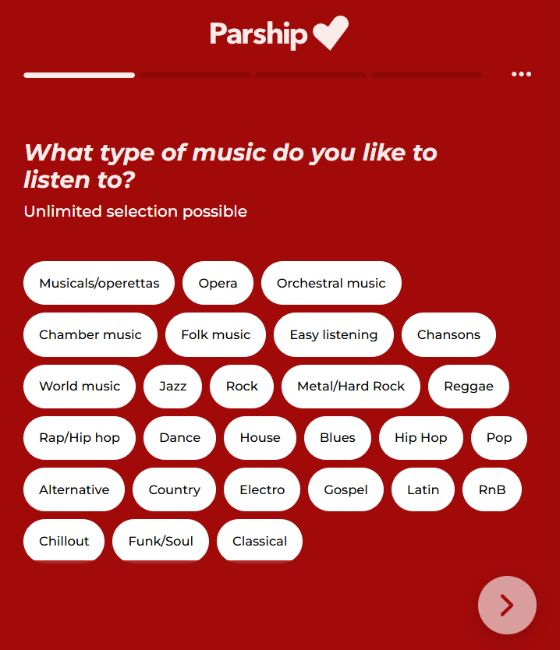
Our registration began with who we were looking for, an email address and a password. The more substantial work came next: four questionnaire sections covering interests, personality, relationships and day-to-day life. These mixed ordinary preferences, relationship situations and abstract image choices.
The one-question-at-a-time presentation is friendly and keeps a large task manageable. Musical tastes and holiday preferences are easy enough; questions about closeness, disagreement and how you respond to other people ask for more thought. That suits the relationship focus, although it takes more commitment than filling in a short biography.
Step 2: Add a profile people can actually read
After the questionnaire, we added practical details and a personal introduction. The profile offers a Factfile, an About me question section, lifestyle interests and entertainment preferences. Our sample answer about an interesting date suggested a quiet coffee and a walk. A specific answer gives somebody a much better starting point than another claim to enjoy having fun.
We skipped the optional photograph and reached 40% completeness. That let us examine the free account, but it is not a model profile for someone hoping to attract attention. The service repeatedly encouraged us to add photos and more answers.
Step 3: Verify your age before entering
Age verification was mandatory in our registration. The screen offered a selfie-video estimate or a credit-card check; the account owner completed that step personally before partner suggestions became accessible. Treat it as a real part of joining, with time and privacy implications, rather than assuming that email registration is the whole process.
An age check has a useful purpose, but it does not tell you whether another person is single, truthful or a good partner. Those judgements still need care.
Profile design: room for a person, not just a picture
Parship’s desktop profile layout separates the personal material from practical facts. On our own profile, an About me answer and lifestyle cards occupied the wider column, while the Factfile sat to the right. Height, smoking, children and relationship circumstances were easy to distinguish from interests and personal writing.
We like that hierarchy. It helps you check an important practical difference without treating a person as nothing more than a list of requirements. The personal questions then leave room for a voice to come through. A good answer about a date or an ordinary weekend is more revealing than a row of agreeable adjectives.
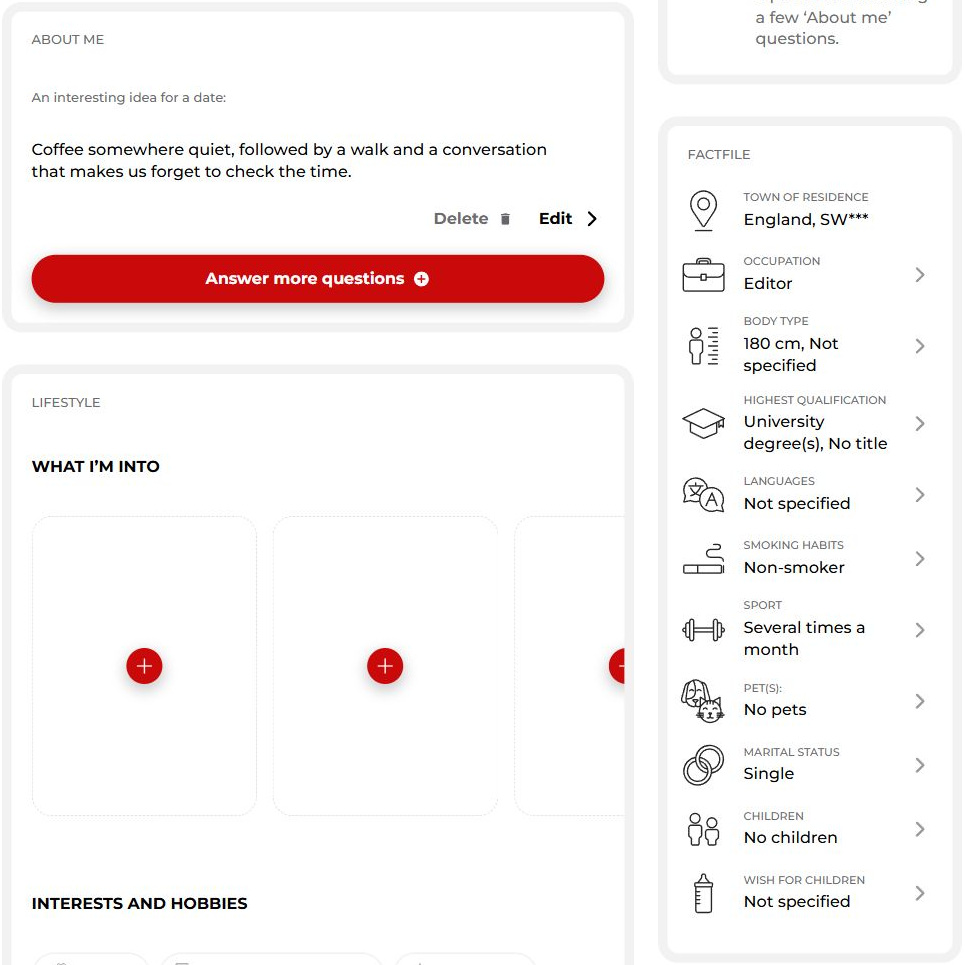
The soft backgrounds, outlined icons and separate rounded cards give the site a calm, approachable feel. Some blocks use a lot of space: an unfinished profile can look rather empty, and there is plenty of scrolling. The structure rewards people who supply something worth reading.
In our narrow browser check, the content stacked into a single column and the main navigation moved into a fixed bottom bar. Profile, Photos and Test result remained separate tabs. It was workable and readable, although the long profile becomes a more extended scroll on a phone-sized screen.
Matching: more explanation, with a paid boundary
Your personality report
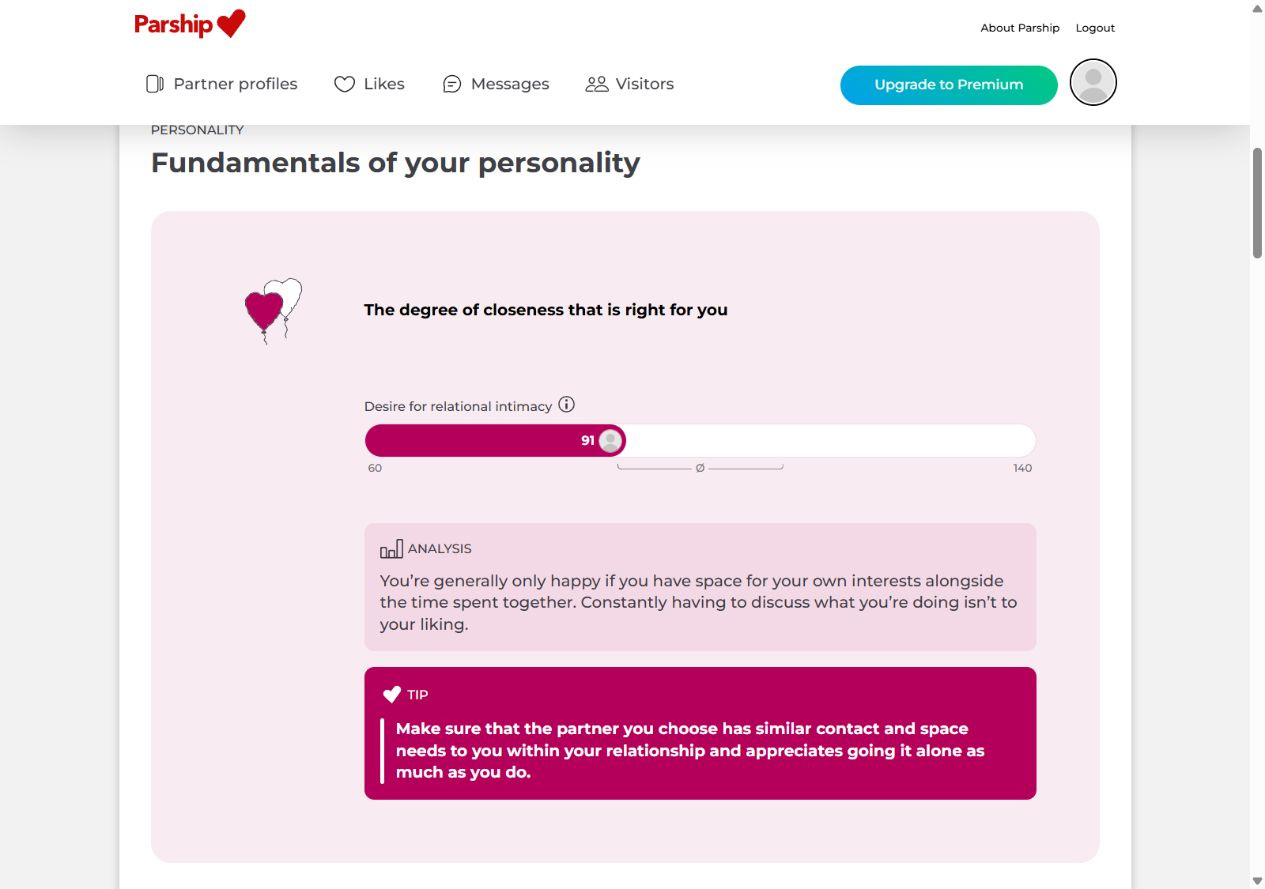
The personality result covers relationship closeness, empathy, outlook, social interaction, compromise and everyday behaviour. The free report gave us a full example about balancing time together with personal space, including an analysis and a practical tip. The remaining explanations repeatedly led to Premium.
That first example is useful because it connects an abstract characteristic to everyday life: how much contact and independence you might want in a relationship. There is more substance here than simply being told that you are a wonderful person. We were less impressed by having so much of the explanation locked away after completing the full questionnaire.
Compatibility between two profiles
When we added German regions as a control, a German-region profile appeared with 109 matching points. Its compatibility panel separated personality, habits and interests; the recorded breakdown was 67%, 48% and 44%. Those are different kinds of information, and showing them separately helps you see what a headline match label is summarising.
That is a sensible presentation. Shared interests may suggest an enjoyable first outing, while habits and relationship expectations matter when the novelty wears off. The percentages remain the system’s assessment, however. They are not a measured probability of chemistry or a successful relationship.
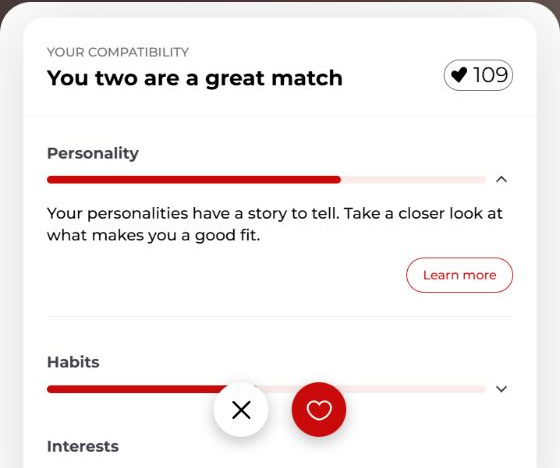
We also noticed an unexplained location inconsistency: the header showed a distance of 9km while the Factfile placed that example in North Rhine-Westphalia and our account was set in London. We could not resolve that discrepancy, so we did not treat the distance as reliable.
Search settings: plenty of scope, limited UK results
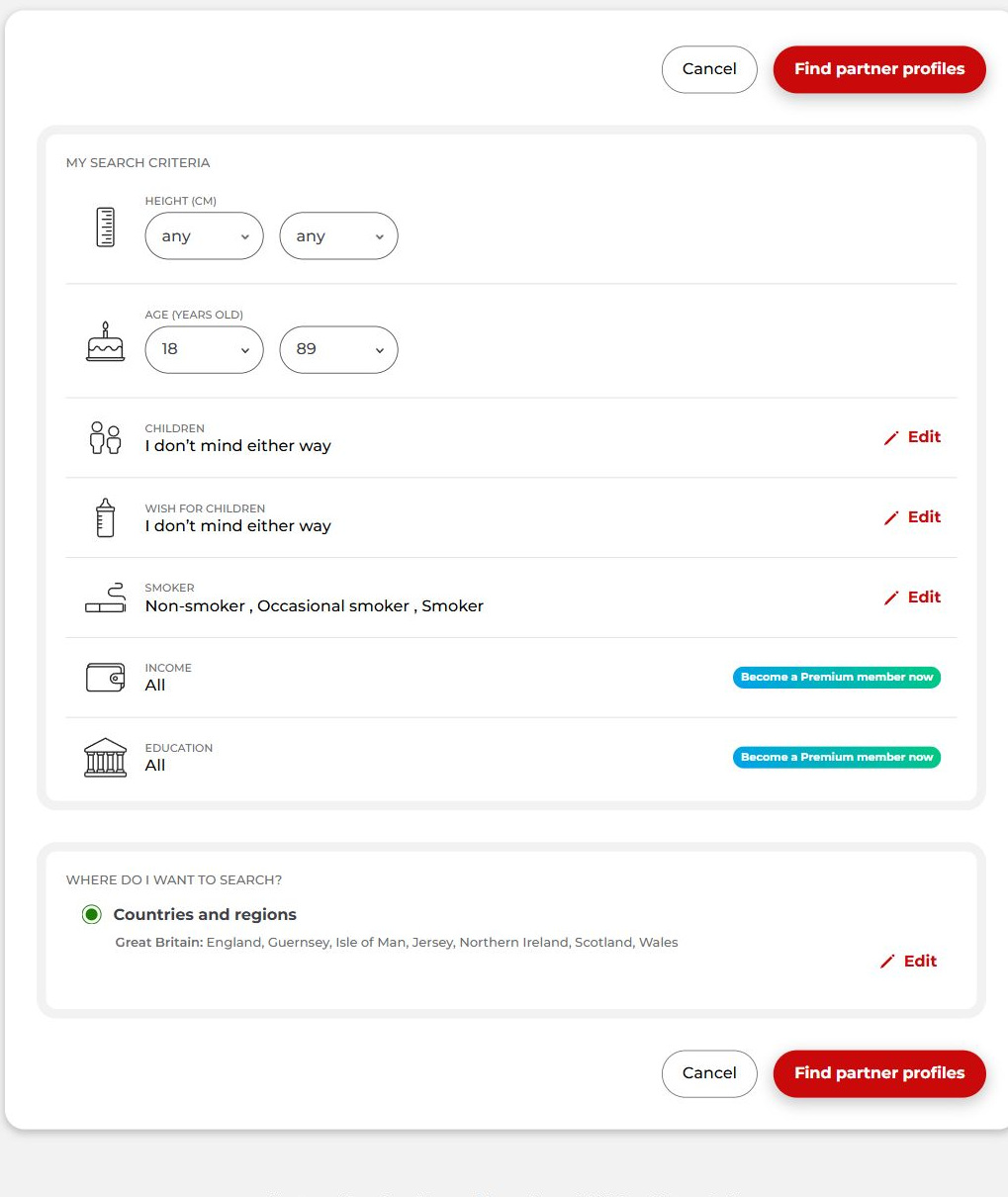
The search screen allowed age and height ranges, children, wish for children, smoking and a country-and-region selection. Income and education carried Premium prompts. Partner suggestions also had music, sport and holiday-interest filters. This is a useful spread of practical and lifestyle considerations, though stacking lots of preferences would naturally make a selection narrower.
We therefore removed those restrictions for the broad UK checks. The service grouped England, Guernsey, Isle of Man, Jersey, Northern Ireland, Scotland and Wales under Great Britain. We selected every listed region. The age controls showed 18 to 89, while the result summary described the range as 18–80+.
UK choice and activity: our searches showed no profiles
Every UK-only search in the test returned the same empty state. Broadening the settings did not produce a small shortlist, an older set of profiles or a first page waiting to load. It produced no profile cards.
| Search | Observed result |
|---|---|
| All listed UK regions, ages 28–41 | No profiles displayed |
| All listed UK regions, age unrestricted | No profiles displayed |
| England only, ages 25–55 | No profiles displayed |
| All listed UK regions, summary 18–80+ | No profiles displayed, including reloads |
| Same broad UK search through a London VPN connection | No profiles displayed after a fresh submission |
| UK plus all German regions, otherwise broad settings | A German-region profile appeared |
The German control matters because it shows that this free account could display a profile. It does not explain the UK failure. The account’s visibility setting was open to all Parship members, and we saw no visible pending-approval or blocked-account banner.
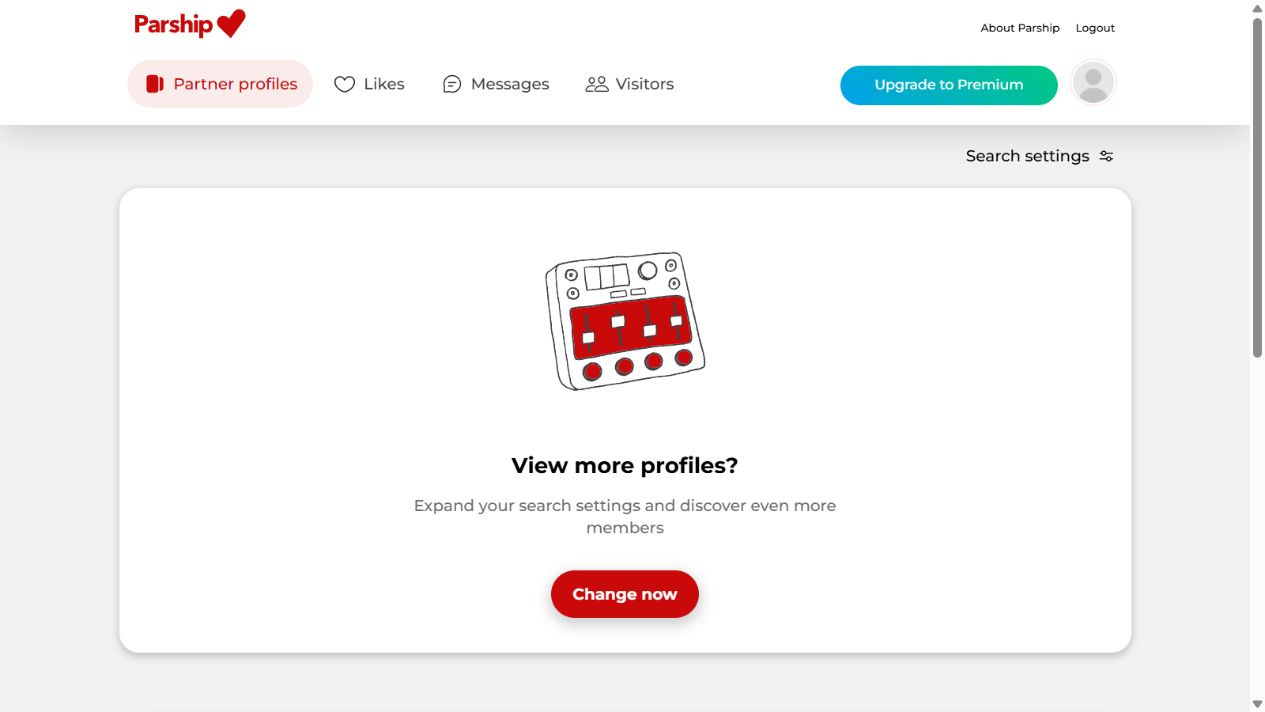
We cannot turn that into a claim that Parship has no British members. We do not have a verified UK membership total, and the underlying cause remains unknown. Nor could we measure a recently active UK count or active share when no UK profiles were shown. The German example’s recent-login marker says nothing about activity in Britain.
For a reader deciding where to spend time and money, the practical conclusion is still clear: our UK search gave us nobody to consider. Parship’s international presence and compatibility features do not cancel out that result.
Likes, messages and the free-versus-paid split
Likes, Messages and Visitors have their own places in the main navigation. The Likes introduction describes an incoming message or shared-interest hint as a way to judge a connection; Messages groups conversations with matches. Our new account had no likes, conversations or visits, which is unsurprising for a fresh editorial profile without a photo and should not be read as a response-rate test.
The format makes sense for a slower, considered approach. Profile answers and shared interests can give a first message something specific to work with. We inspected the layout and descriptions without contacting anyone.
| Feature | Basic | Premium |
|---|---|---|
| Registration, questionnaire and profile | Included | Included |
| Personality analysis | Limited preview | Full analyses and tips advertised |
| Suggested profiles and compatibility | Accessible; no UK results in our test | Regularly updated suggestions advertised |
| Photos | Generally obscured | All photos advertised |
| Communication | Restricted | Unlimited communication advertised |
| Distance-based local search and visitor list | Advertised as Premium benefits | Included in the Premium description |
The official membership overview says a Basic member can reply once to a personal message from a Premium member. That is a narrow allowance, rather than a full free conversation. We did not exercise it. Paid communication also depends on there being somebody relevant to contact.
Parship prices: the full commitment
Our account’s plan-selection screen displayed the following UK pound prices, including VAT. The totals below are calculated from those monthly equivalents and terms.
| Plan | Term | Per month | Initial total |
|---|---|---|---|
| Premium lite | 3 months | £29.90 | £89.70 |
| Premium classic | 6 months | £19.90 | £119.40 |
| Premium comfort | 12 months | £14.90 | £178.80 |
Parship’s published UK price page states that the chosen term is charged as one payment and that memberships renew automatically. A monthly equivalent is not a one-month contract. Offers can be personalised, so check your own final price, renewal term and renewal amount before making a commitment. We did not enter payment details or complete a purchase.
The longer plans reduce the equivalent monthly rate, but the twelve-month option still commits £178.80 initially. We cannot see a good reason to make that commitment when our UK selection displayed no profiles. Paying is not an evidenced solution to the empty results.
The contact guarantee needs clarification
The plan cards advertised a contact guarantee on six and twelve months, while the benefits heading said “as of 6 months”. The expanded explanation then referred to three- and nine-month terms as well. That is inconsistent information, particularly when the current cards offer three, six and twelve months.
The explanation describes a conditional free extension, with requirements including a completed About me section, at least one photo and a minimum number of contact requests. It is not a promise of dates, a relationship or your money back. An extension would be of little comfort if the selection remained empty. Get the exact conditions for your offered plan before relying on it.
Renewal and cancellation
For website purchases, the current UK terms describe cancellation through Data & Settings → Manage profile → Amend subscription, or by writing to the service. Renewal duration and price are those agreed at purchase. Ending renewal normally leaves the initial commitment running to its end. App-store purchases are managed with the relevant store. Keep the confirmation and check the terms attached to your own subscription.
Relationship intentions, safety and privacy
Parship’s serious-relationship positioning fits the product we saw: the questionnaire asks about how a couple might live together, the Factfile includes family circumstances, and personal questions offer more than a quick visual judgement. That creates a useful framework for a deliberate partner search. It cannot establish what every member wants.
The mandatory age check added a tangible hurdle in our registration. We did not test reporting outcomes, moderation response times or other members’ identities, so those remain outside our hands-on judgement.
One privacy point is easy to miss: the UK terms say profile information is visible across Parship’s international markets and grant broad rights over profile content, including marketing and AI uses. Read those provisions before adding personal material. The relevant question is whether you are comfortable with that use of what you publish, as well as who can see your profile.
What other users say
The Parship Trustpilot profile we could inspect contains feedback from several European markets, so it is not a UK membership survey. We found praise for the platform alongside complaints about subscription costs, cancellation and limited choice. Individual reviewers also questioned the matching approach.
Those experiences are useful context for reading the commitment carefully. They do not establish why our UK search was empty or prove accusations about fake profiles. Our recommendation rests on our own observed UK result and the current product and price evidence.
Frequently asked questions
No. Our repeated searches for women showed no UK profiles, including every UK region listed by the service and the broad 18–80+ result-summary range through a London connection. This describes our account and test date; it does not establish that Parship has zero UK members.
Registration, the questionnaire, profile creation and limited browsing are free. The personality report is a preview. Full analyses, photos and communication are advertised as Premium benefits, alongside local distance search and the visitor list.
Our plan screen displayed Premium lite for 3 months at £29.90/month (£89.70 total), classic for 6 months at £19.90/month (£119.40 total), and comfort for 12 months at £14.90/month (£178.80 total), including VAT. Totals are calculated from the shown terms. Parship says the initial term is paid in one payment; plans auto-renew and personalised offers can differ.
They summarise the system’s compatibility assessment. The German-region profile we inspected showed 109 points with separate personality, habits and interests sections. This is not a measured probability of chemistry or relationship success.
We have no evidence that it does. The free account could display a German-region profile, while our UK searches stayed empty. We did not buy Premium and do not recommend paying on the assumption that UK profiles will then appear.
We checked the desktop and mobile website. We did not test the native apps, send likes or messages, or purchase a subscription.
Not on our current evidence. The profile and compatibility tools have strengths, but our test gave us no UK profiles to consider. That practical problem outweighs the theoretical appeal of the matching system.
Our verdict: a UK recommendation needs UK choice
There is a credible idea at the centre of Parship: take the time to understand people, give their profiles some depth, and explain compatibility through more than a photograph. We liked the separate facts and personal answers, and the personality report offered a useful glimpse of how relationship preferences can affect everyday life.
Our British test fell down on something more basic. We could not find a single UK profile, even after broadening the filters and repeating the search through a London connection. We cannot explain that result or turn it into a membership census. We can say that it left us without a practical reason to subscribe.
We do not currently recommend Parship for dating in Britain. Compare the options in our UK dating sites guide or dating apps comparison, and look for a relevant local selection before committing to a paid term.
Parship · 2.4/5 · Poor
Thoughtful matching tools, but no UK profiles displayed in our test.
Official website
Compare before you choose
Alternatives to Parship

Match
4.4Very good
A mainstream relationship service with another approach to browsing and discovery.
Ad

Ourtime
4.2Very good
A relationship-focused community for singles aged 50 and over.
Ad

eharmony
4.0Very good
Detailed profiles and compatibility insights for a considered partner search.
Ad